

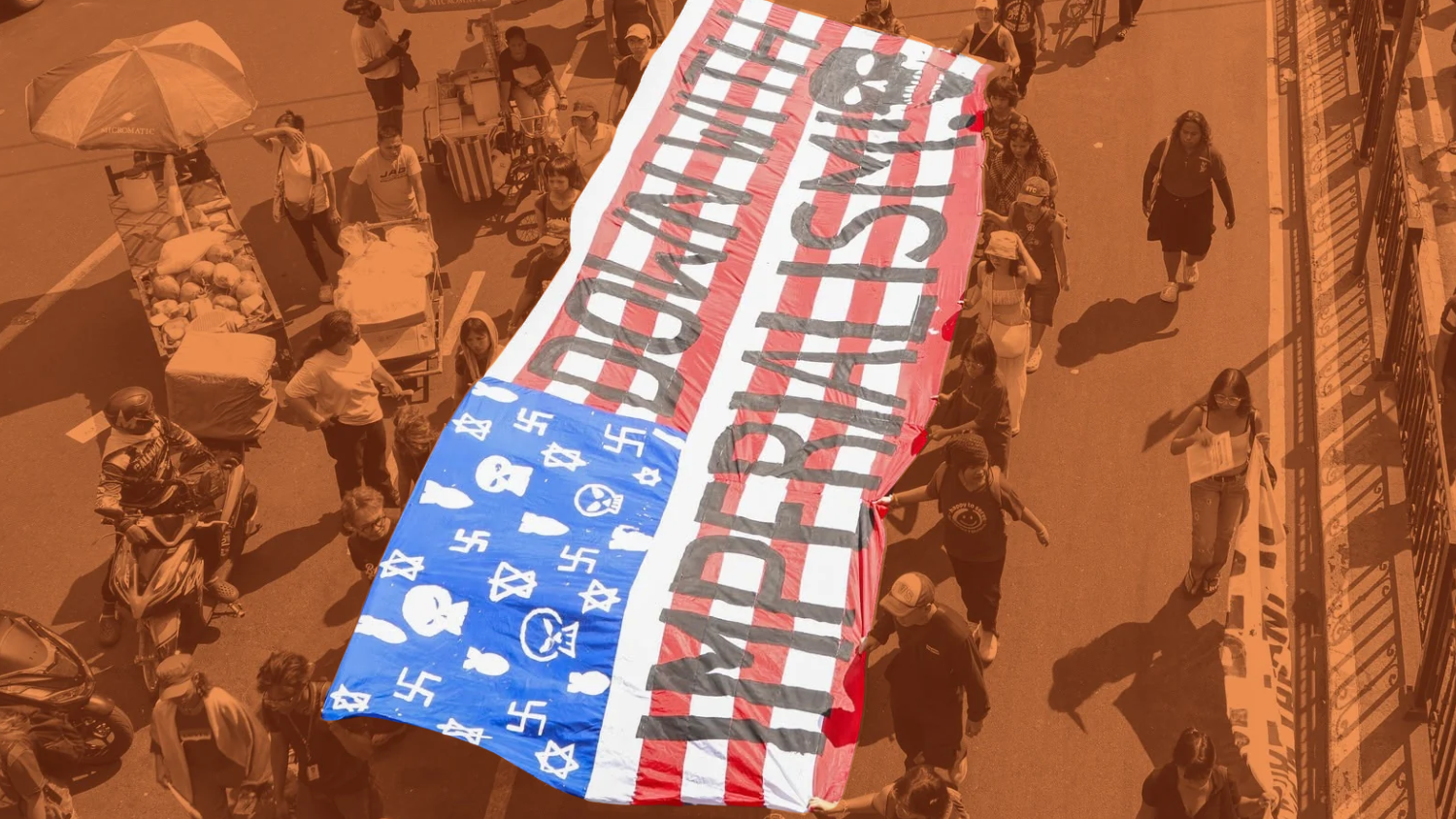
Groups during the 2026 State of the Nation Address (SONA) protests demanding an end to US Imperialism
United States (US) imperialism is a system of global dominance where the US exerts direct and indirect military force, economic coercion, and political and cultural influence on other states to maintain hegemony. In Lenin’s theory, this is the highest stage of capitalism, wherein states expand their influence beyond national borders in search of markets, resources, and strategic advantage. As a country whose power is primarily anchored in territorial conquest, the persistence of U.S. imperialism is embedded in a “postcolonial organization of political space” that upholds the formal autonomy of states, while actually controlling and exploiting their human and natural resources through capitalist accumulation. Hence, it is maintained not only through coercion, but also through the normalization of unequal relations. It is, essentially, a system that thrives on human rights violations.
US Imperialism in West Asia — not just a regional conflict
West Asia serves as one of the primary sites of this strategy. Take the Israel-led genocide of Palestinians and the US-Iran War, for instance. Israel has been committing mass atrocities on Palestinian territories for decades, with the past three years marking only the most recent operations in a long history of systematically annihilating Palestinian life and culture.
On the other hand, the hostilities between the US and Iran are traced back to 1979 when Iranians deposed the US-backed Shah Mohammad Rehza Palavi and installed an Islamic Republic. In February 2026, the US launched a series of bombings on Iranian nuclear facilities and civilian infrastructure—including schools, medical facilities, and health research institutions—making it clear that the friction between both states is far from over.
Both phenomena are often seen as separate crises (which is valid as they have distinct historical trajectories), but viewing them as entirely separate conflicts may obscure the broader system that connects them. Rather, these crises should be understood as interconnected fronts of a broader imperial system: US backing of Israel facilitates occupation and suppresses Palestinian self-determination, while the war with Iran deepens regional instability and upholds US hegemonic interests.
Viewing these conflicts as interlinked phenomena reveals how imperialism produces economic and humanitarian implications that extend beyond the region, especially in developing countries like the Philippines.
U.S-Israel relations have strengthened over the years due to mutual interests. The United States’ $38 billion, decade-long military aid commitment (2019–2028) to Israel is widely viewed as a key factor sustaining Israel’s military capacity and, by extension, the persistence of its occupation of Palestine. More broadly, this partnership positions Israel as a critical strategic ally through which the United States helps secure influence over vital energy resources and trade routes in the region.
Scholars argue that this structural alignment has effectively transformed the US into “Israel’s lawyer” rather than a neutral mediator, prioritizing Israeli security interests over Palestinian lives and self-determination. For instance, it must be remembered that the US vetoed the United Nations (UN) Security Council resolutions for a ceasefire in Gaza, six times; and after US President Donald Trump announced his 20-point “peace plan” to set the terms of a ceasefire, on October 13, 2025, this remained a ceasefire only in name as Israel has continued to bomb and kill Palestinians.
This imperial strategy extends to the US-Iran War—evolving from proxy wars to direct state-on-state targeting, with the US and Israel launching joint operations in Iran in February 2026. These actions are frequently legitimized through rhetorical devices that discredit Iran as an enemy that must be suppressed, while portraying the US-Israeli alliance as a rational defender of democracy. The war is also justified due to Iran’s alleged possession of nuclear weapons.
Beyond West Asia, the conflict has instigated a global economic catastrophe.
Humanitarian implications for the Philippines
The global implications of the US-Israel war on Iran show that the humanitarian costs of imperialism are not geographically bound. Countries with deep-seated ties to the US are especially vulnerable to its effects. The Philippines, in particular, functions as an integral component of the US war machine.* This is defined by a century of strategic subordination, evolving from direct colonial occupation to its current position as one of the United States’ “strategic client states” to advance its interests.
*Note: The “U.S. War Machine” refers to the global network of American military power that enables the United States to maintain dominance. This positions the Philippines as a strategic hub for projecting military influence in the Indo-Pacific, and highlights how U.S. military presence integrates the country into broader American war planning. See Roland Simbulan’s “The U.S. Global War Machine in the PH” from the Philippine Daily Inquirer.
This role is institutionalized through agreements such as the 1951 Mutual Defense Treaty (MDT), the 1998 Visiting Forces Agreement (VFA), and the 2014 Enhanced Defense Cooperation Agreement (EDCA), which strengthen the asymmetrical relations between the Philippines and the US. This structural subordination impels the Philippines to bear the brunt of imperialist-led aggression through a globalized polycrisis, where soaring oil prices and energy panics are not merely products of market forces but the direct domestic fallout of a foreign policy framework dependent on the US at the expense of Filipino humanitarian security. The Philippines imports 90% of its crude oil and has limited energy reserves; combined with the disruption of shipping lanes in the Strait of Hormuz, the crisis has gutted the domestic economy.
By mid-March 2026, diesel prices in the National Capital Region surged toward P100 per liter, an 80% increase since the conflict began. While the war in West Asia has disrupted the global economy, the primary driver of this economic shock in the Philippines is a neoliberal, foreign-dependent economic policy, not the blockade per se.
Even prior to the crisis, long-standing patterns of imperialism and structural subordination ensured that crude oil prices in the country were already high, while Filipino wages remained depressed. The severity of the fuel crisis is thus a direct consequence of neoliberal policy frameworks, specifically the Oil Deregulation Law imposed by the International Monetary Fund (IMF) through conditional loans, which have deepened import dependence and suppressed domestic capacity.
The Philippine government has been slow to address the crisis, refusing to reduce or eliminate taxes on crude oil and passing the full burden of global price hikes to the masses. This humanitarian toll is highly visible in the transport sector, where thousands of jeepney drivers have seen their earnings decline to the point where it is no longer sufficient for daily living. It has revealed the structural precarities of Filipinos in crisis situations, with the oil shocks coinciding with the highest unemployment rate the Philippines has seen since the start of the Marcos Jr. administration, as recorded in January 2026.
Data from as early as February 2026 showed that millions of families will inevitably be pushed into deeper poverty during this crisis. True enough, inflation has continued to push the prices of basic commodities upward; and with government interventions being “too small for too few”, the poorest families whose household incomes were already too little to begin with are now struggling even more to keep up and survive—pulling them even further away from their right to living life with dignity.
Moreover, over 2.44 million Overseas Filipino Workers (OFWs) in West Asia are stranded in the war zone. The conflict has already resulted in the death of at least one Filipino worker in Israel and has left thousands of others stranded due to airspace closures. The emotional and financial impact on Filipino families is immense as they face the dual anxiety of losing loved ones and the danger of losing their jobs, affecting the income that sustains them.
Towards an Independent Philippine Foreign Policy
In response to the humanitarian crises, a broad coalition of progressive groups and civil society organizations has mobilized against the US-led military aggression and the inadequate response of the Philippine government. Transport federations such as Pagkakaisa ng mga Samahan ng Tsuper at Opereytor Nationwide (PISTON)* have spearheaded national strikes and protests, dismissing the government’s emergency measures as merely band-aid solutions and demanding the repeal of the Oil Deregulation Law. Beyond economic grievances, organizations have demanded a decisive shift toward an independent foreign policy, urging the administration to detach itself from the US strategy for war and prioritize Filipino interests above all.
*Note: Pagkakaisa ng mga Samahan ng Tsuper at Operator Nationwide (Solidarity of Drivers and Operators’ Organizations Nationwide) or PISTON is a federation of public transport groups and associations in the Philippines.
This systemic instability highlights how imperialism sustains cycles of violence that transcend borders. As US–China tensions escalate, the call for an independent foreign policy should be heightened now more than ever, so the Philippines can avoid being used as a pawn by the US and freely advance its own interests. Only through a foreign policy focused on national autonomy can the Philippines safeguard the Filipino people.
This is not only a political stance, but also a humanitarian imperative.
With inputs from PhilRights staff