

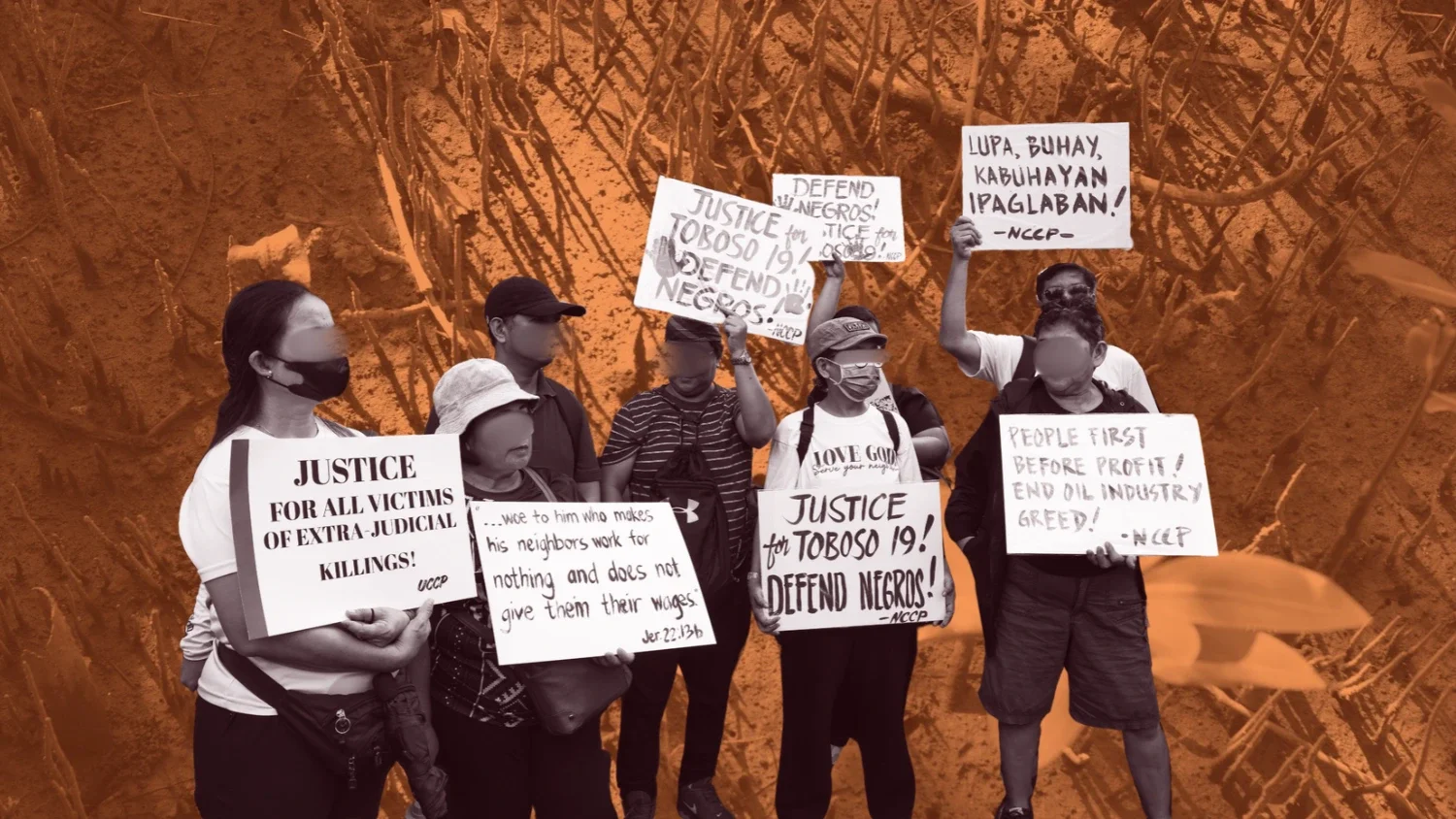
What the Ground Remembers
A common refrain that emerged after it was known that civilians were killed in the Toboso operation was “Why were these civilians there?” Setting aside the fault-finding, and, yes, victim-blaming timbre of this question, it is important to consider that the events surrounding the killings of the Toboso 19 reach back to, and at the same time instantiate, the grim realities of Negros Island as a hotbed of violence.
With Exploitation As Economic Logic, Insurgency Ensues
Negros Island is sugarlandia. Fundamental to that identity is its centuries-long history of dispossession, exploitation, and bone-deep poverty enacted through the sakada system. Multiple generations of sugar workers tilled the land, lived, and died without experiencing a fraction of the rewards of their labor. Instead, the spoils remained firmly in the hands of the Philippines’ planter class, enabled and coddled by the State, creating a system that ensures poverty that is structural and endemic.
It is these conditions where there is systematic denial of legal recourse and avenues for socioeconomic justice that reflect how State obligations have remained unmet for generations. The result is that the exploited will likely channel their demand for justice through other means, armed and unarmed alike. The New People’s Army’s (NPA) continued presence in the island may be understood as a standing indictment of the State’s failures to resolve the socioeconomic conditions from which insurgency emerges. These unmet obligations predate the NPA’s formation and will outlast any single counterinsurgency operation. This is to say that the Toboso 19 killings are not happenstance. They are but the latest instance in a pattern of enacted State violence in Negros Island.
The killings also serve as a chilling reminder of the 1985 Escalante Massacre. Toboso is about 30 minutes away from the town of Escalante, where members of the State-sanctioned paramilitary Civilian Home Defense Forces (CHDF) as well as police and military units, opened fire on protesting farmers, killing several. Those who were able to run away were chased down, further raising the kill count. By the end of September 20, 1985, 20 sakadas and student leaders were killed.
Still, the years between the massacres in Escalante and in Toboso were far from bloodless. With the terrain rife with militarized land disputes, private armies operating with impunity, and a government unwilling to address grievances, violence tends to erupt. Case in point, the Sagay Massacre in 2018 left nine dead, among them two children, after alleged members of a private army shot workers assembled in disputed land in a sugar plantation. Sagay, also a Negros Occidental town, is less than an hour’s drive away from Toboso.
In 2023, four members of the Fausto family of Himamaylan, Negros Occidental, were killed by unknown perpetrators. Spouses Roly and Emelda Fausto, who were agricultural workers and activists, reported being red-tagged prior to their killings. The police allege that 15 armed perpetrators murdered the couple and their two young sons, Ben and Ravin, aged 15 and 12. Rights groups however believe that these killings were committed by the military.
It is through this broader context that we can better understand Toboso and the individuals who were killed there on April 19, 2026. In truth, the contours of this violence have been defined long before April 19, and the Toboso 19 killings underline and affirm their terrifying and current reality.
Bearing Witness Should Not Lead to Murder
The days following the operation saw confirmation from various quarters on the identities and affiliations of the nine civilians killed during the operation. They turned out to be community journalists, students, activists, farmers, and children. To regard what happened to them as being at the wrong place at the wrong time would mean willfully ignoring the broader truths as to why they were where they were, and why their lives were so cruelly taken away.
We have Ledesma, who was in town for immersion reporting on the displacement of farming communities by solar farm and windmill projects. Had he lived, this work would have shed further light on how these green projects become variants of the same instrument of dispossession as the hacienda system.
There’s Alano, who was actively working with and learning from the local community to further ground policy advocacy in the lived realities of the basic sectors. There’s also Wendel, who was writing a situationer report on current conditions of Negros sakadas, and Santuyo, who was doing precisely what her profession had asked of her: on-the-ground organizing work.
Prijoles and Sorem were two Filipino-Americans who travelled halfway across the globe to understand the struggles of Negros agricultural workers exactly where they were situated. Then there’s Sabillo, only 19, and the two unnamed minors—whose young lives were violently stolen in the one place they called home.
None of them were in Toboso by accident. Their being in Toboso was a direct response to the realities of living and working in Negros Island. As members of civil society from various parts of the country and the Filipino diaspora, they saw fit to document and bear witness to the plight of the marginalized while highlighting the multitude of human rights violations committed against them. They may have come to Toboso from disparate places and means, but they were animated by a collective impulse to demand better.
In return, they were met with violence and death.
Seeking Accountability
Still, we must resist having Toboso 19 become just one more entry in the State’s bloody ledger and leave it at that. These are lives lost, and their families deserve answers from the Philippine government.
In demanding accountability, we need independent fact-finding. We also need evidence, however scant at this point, to be preserved and examined by experts. Families deserve access to psychosocial services, and potential informants who can provide factual accounts need witness protection. The Commission on Human Rights (CHR), particularly its Negros Island Region Office, faces a tall order as it proceeds with its investigation.
There is also exceptional cruelty in the fact that Wendel’s body has not been returned to his family to date. In June, Wendel’s family spoke before the media to urge authorities to exhume a body that they now believe to be that of their son. Whether due to incompetence, carelessness, or outright malice, a body was misidentified as Wendel’s and turned over to the family. Dr. Raquel Fortun’s forensic examination revealed that the body could not possibly be Wendel. Speaking in Filipino, his mother decried the inhumanity of the situation, saying “It is painful for us that my child has still not been returned to us, and we have not been able to give them a proper burial.”
At the policy level, the Philippine government must urgently study the repeal of Memorandum Order No. 32, a Duterte-era policy that ushered in a massive wave of military deployment in Negros Island, as well as Samar and the Bicol Region—all hotspots of counterinsurgency operations.
From its inception in 2018, the memorandum order has been instrumental in repeated human rights violations in its areas of implementation. A 2020 report on the Philippines by the United Nations Office of the High Commissioner for Human Rights (OHCHR) linked the memorandum order to violations such as alleged killings and arbitrary detention during joint police-military operations, as well as alleged violations of IHL in the conduct of aerial bombing operations. The report further recommended that the Philippine government rescind Memorandum Order No. 32.
The whole situation surrounding Toboso 19 is a horrifying but urgent reminder that armed conflict does not grant exemptions from the State’s obligations to respect the life and dignity of everyone. Indeed, the universality and inherent nature of human rights mean that our rights and dignity as human beings must continue to be upheld regardless of circumstances.
The families of the Toboso 19 deserve a full accounting of what transpired so that justice can be sought and perpetrators can be held accountable. Anything less would be a betrayal of the Philippines’ commitment to human rights. Anything less would instead support the further entrenchment of a culture of impunity and violence, from which lasting peace will never be possible.
May justice and accountability prevail.
Editor's Note: Shortly after the writing of this article, a National Fact-Finding and Solidarity Mission (NFFSM), which was participated in by national, local, and international organizations, announced its findings from a four-month investigation on the killings at Toboso. The document containing their findings has yet to be published online, but reports from the Philippine Daily Inquirer, AlterMidya, and Bulatlat provide key details from it.